Mount Sinai
Mount Sinai and Saint Catherine's Monastery: how to plan the climb
Climbing Mount Sinai for sunrise and visiting Saint Catherine's Monastery: trails, timing, season, access from Sharm el-Sheikh or Dahab, and what official travel advice says.
By Ali Jalal, Spanish- & Italian-speaking guidePublished on
In brief
Mount Sinai, Gebel Musa to the Bedouin, is the mountain where tradition places the giving of the Tablets of the Law to Moses. You climb it at night to watch the sun rise over the Sinai ranges, then come down to visit Saint Catherine's Monastery at its foot. Here is how to plan the day, and why we recommend sleeping nearby.
- Altitude: 2,285 metres at the summit, about 1,570 metres at the monastery
- Climb: two and a half to three hours, with a Bedouin guide
- Difficulty: a steady walk with no technical sections, fine for a reasonably fit walker
- Monastery: open in the morning only, closed on Sundays and Orthodox feast days
- Best season: March to May and October to November, winter nights at the summit are freezing
- Access: about three hours by road from Sharm el-Sheikh, two hours from Dahab
- With us: a night in Saint Catherine, the climb, the monastery and a daytime return
Why climb Mount Sinai?
Because it is one of the rare places held sacred by Judaism, Christianity and Islam alike, and one of the finest sunrises in Egypt. All three traditions identify Gebel Musa, the mountain of Moses, with the biblical Sinai. At the summit, a small Chapel of the Holy Trinity and a modest mosque stand side by side. The site, with the monastery and the surrounding mountains, has been a UNESCO World Heritage Site since 2002 under the name Saint Catherine Area.
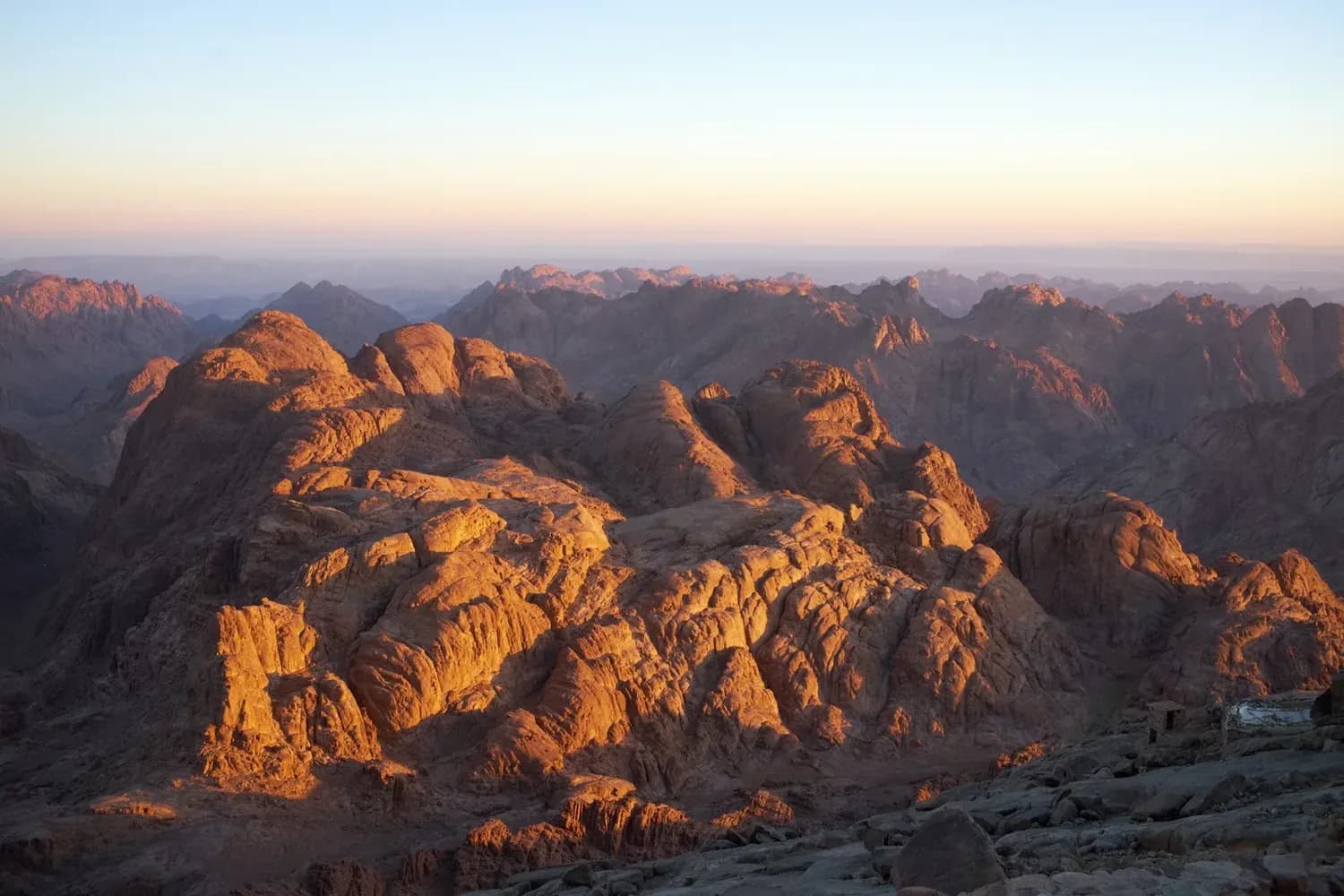
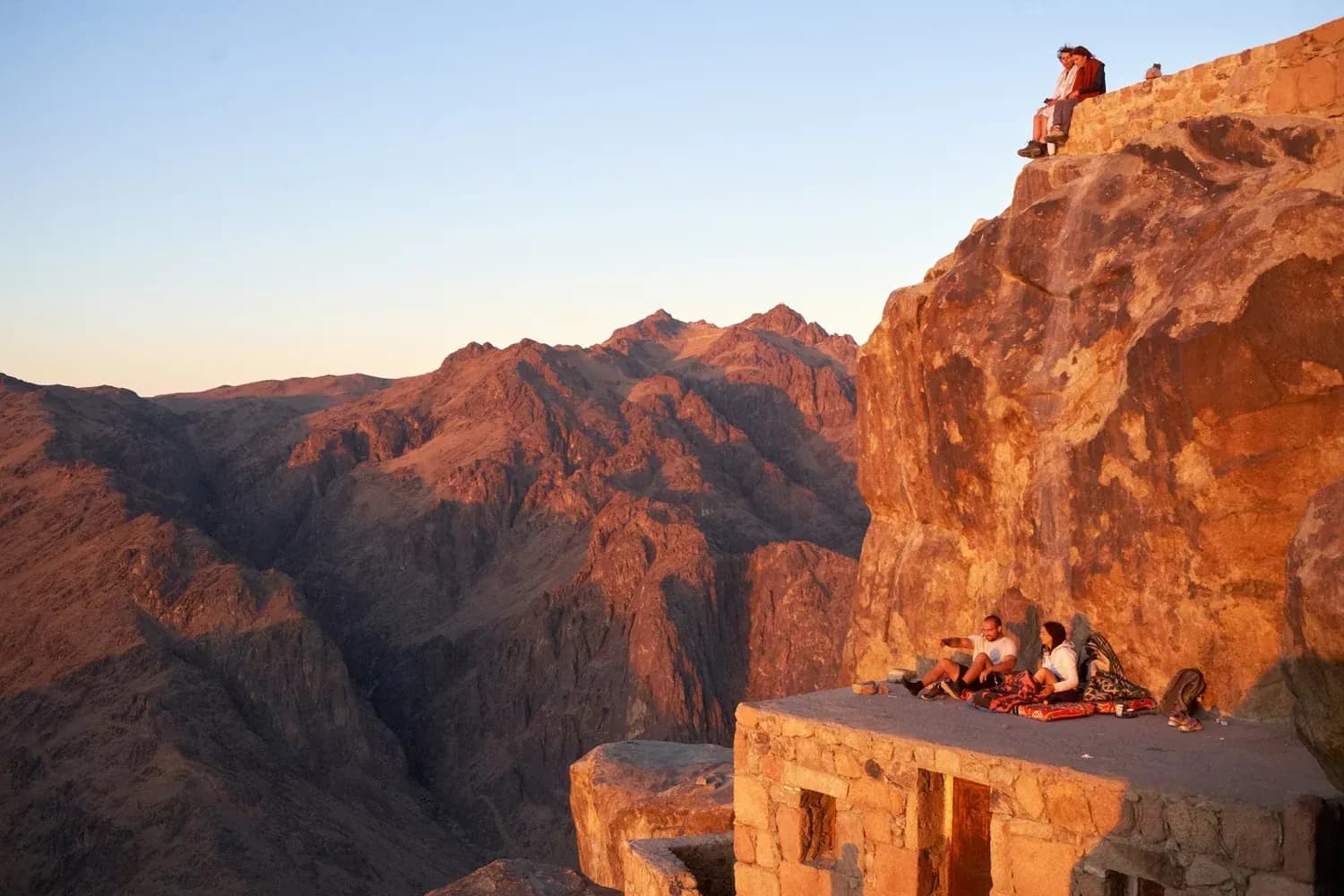
What you come for is a moment. You walk in the dark by headlamp, among dozens of pilgrims and travellers from all over the world. Then the sky pales, and the red granite ridges emerge from the shadow one after another as far as the horizon. It is a thing apart in a trip to Egypt, very different from the temples of the Nile valley, and it pairs naturally with a stay on the Red Sea.
How does the Mount Sinai climb work?
The climb is done at night, with a Bedouin guide, in two and a half to three hours. You set off in front of the monastery around two in the morning, depending on the season, to reach the summit before dawn. The guides belong to the Jebeliya tribe, keepers of the mountain for centuries, and you must be accompanied by one to climb.
Two routes lead to the top. The camel path, wide and evenly graded, is the one used at night. It ends about 750 steps below the summit, which everyone climbs on foot, camel or not. The Steps of Repentance, cut by the monks, count about 3,750 uneven stone steps: they are best kept for the descent, in daylight, for the view over the monastery. Bedouin shelters line the way and sell hot tea, water and blankets.
The walk has no technical difficulty, but it needs sound legs and breath: around 700 metres of ascent, at altitude, in the middle of the night. A camel can carry less sporty walkers over most of the path. We advise against the climb for anyone with heart problems or weak knees, and we discuss it with every traveller before scheduling it.
What is there to see at Saint Catherine's Monastery?
Saint Catherine's Monastery is the oldest Christian monastery still in use, founded in the sixth century on the orders of Emperor Justinian at the foot of Mount Sinai. A small community of Greek Orthodox monks still lives there, behind granite walls. The visit is short and takes place in the morning: the monks open only part of the enclosure.
The monastery is normally open in the morning, from about 9 am to 11.30 am, closed on Sundays and Orthodox feast days, with reduced or no access on Fridays depending on the period. These hours change without notice: we check them the day before. Shoulders and knees must be covered, for men and women alike.
- The Burning Bush, a bramble that tradition presents as the one from which God spoke to Moses
- The Basilica of the Transfiguration, with its sixth century apse mosaic
- The museum and its icons, among the oldest in the Christian world
- The library, one of the most important collections of ancient manuscripts, where the Codex Sinaiticus was found
- The small Fatimid era mosque, built inside the walls themselves
- Moses' Well, where tradition places his meeting with Zipporah
Should you leave Sharm el-Sheikh at night or sleep in Saint Catherine?
We recommend sleeping in Saint Catherine. The excursion sold in Sharm el-Sheikh hotels leaves around 11 pm, drives three hours through the night, goes straight into the climb without sleep and returns around midday. It can be done, but it is exhausting, and it means hours on desert roads in the dark, which we avoid on every itinerary.
Arriving the day before, in daylight, you have dinner and sleep a few hours in one of the village's ecolodges or small hotels, minutes from the trailhead. You climb rested, visit the monastery as it opens, and drive back to the Red Sea in broad daylight. It is safer, more comfortable, and you finally see the landscape you are crossing.
When to climb Mount Sinai and what is the weather like at the top?
The best months are March, April, May, October and November: cool but bearable nights, mild days for the descent. In winter, from December to February, the temperature drops below zero at the summit before dawn, and snow is not unusual. The climb is still possible, provided you are properly equipped. In summer, the night at altitude is pleasant, but the descent in the sun quickly becomes gruelling.
- A headlamp, essential on the trail
- A down jacket or thick fleece, a hat and gloves, even in spring
- Good walking shoes, the Steps of Repentance are slippery
- A litre and a half of water and some snacks
- Clothes covering shoulders and knees for the monastery
- A few Egyptian pound notes for tea, a blanket or a camel
Is Mount Sinai safe? What does official travel advice say?
The UK Foreign Office advice, updated on 27 October 2026, describes the Red Sea tourist areas of southern Sinai as generally low risk. It advises against all travel to North Sinai, and against all but essential travel to the northern part of South Sinai beyond the St Catherine to Nuweiba road, except for the coastal areas. The monastery and Mount Sinai are not named: check the live map before booking, as travelling against FCDO advice can invalidate your insurance.
Other governments draw the lines differently: the US, Australian and Canadian advisories each have their own map, and the one that counts is the one for your passport. Mount Sinai is never a place to wander alone: we organise every climb with a licensed Bedouin guide and a daytime transfer. The zone by zone detail is in our Egypt safety guide.
How do you fit Mount Sinai into a trip to Egypt?
The simplest way is to add it to a stay in Sharm el-Sheikh, allowing two days and one night. The temples of the Nile valley are then reached by air. If your stay remains in southern Sinai, Saint Catherine included, the 15 day entry stamp specific to this area may be enough; as soon as the itinerary includes Cairo or Luxor, the full visa is required again. The details are in our entry requirements guide.
A word on what you will see on arrival: a vast tourism development project, called the Great Transfiguration, has been reshaping the outskirts of the village for several years, with hotels, a visitor centre and new roads. As of autumn 2026, no official opening date has been announced for these facilities, and the works remain visible. The monastery and the mountain are visited as normal.
With us, the climb is arranged as an extension of our Sharm el-Sheikh tour or of any tailor made Red Sea trip: private daytime transfer, a night in Saint Catherine, a Bedouin guide, and a visit of the monastery led by an Egyptologist. Tell us your dates, and we will check the monastery's opening days before proposing an itinerary.
Related tours
Our trips that match this theme.

Also worth exploring
Égypte
Got a trip in mind?
Tell us what you're after: we'll craft a tailor-made itinerary and reply within 24h, no commitment.
Request a quote