Iconic sites
Abu Simbel: how to visit the temples of Ramesses II
Three hours by road from Aswan or forty five minutes by plane, two temples carved into a cliff and a twenty metre facade: our Egyptologists explain how to plan a visit to Abu Simbel, what time to be there and when the sun festival really is worth the trip.
By Ali Mahjoub, Spanish-speaking guidePublished on Updated on
In brief
Abu Simbel is visited as a day trip from Aswan, and that day turns almost entirely on one decision: what time you get there. The two temples of Ramesses II stand about 280 kilometres south of the city, deep in the Nubian desert, some forty kilometres from the Sudanese border. Allow three hours by road or forty five minutes by plane. Those who arrive at opening time have the facade to themselves, with the morning sun lighting the colossi head on; those who arrive late morning find the same site at forty degrees and behind several coachloads. Here are the markers we give our travellers before every departure.
- Two temples carved into the cliff: the great temple of Ramesses II and the small temple of Nefertari
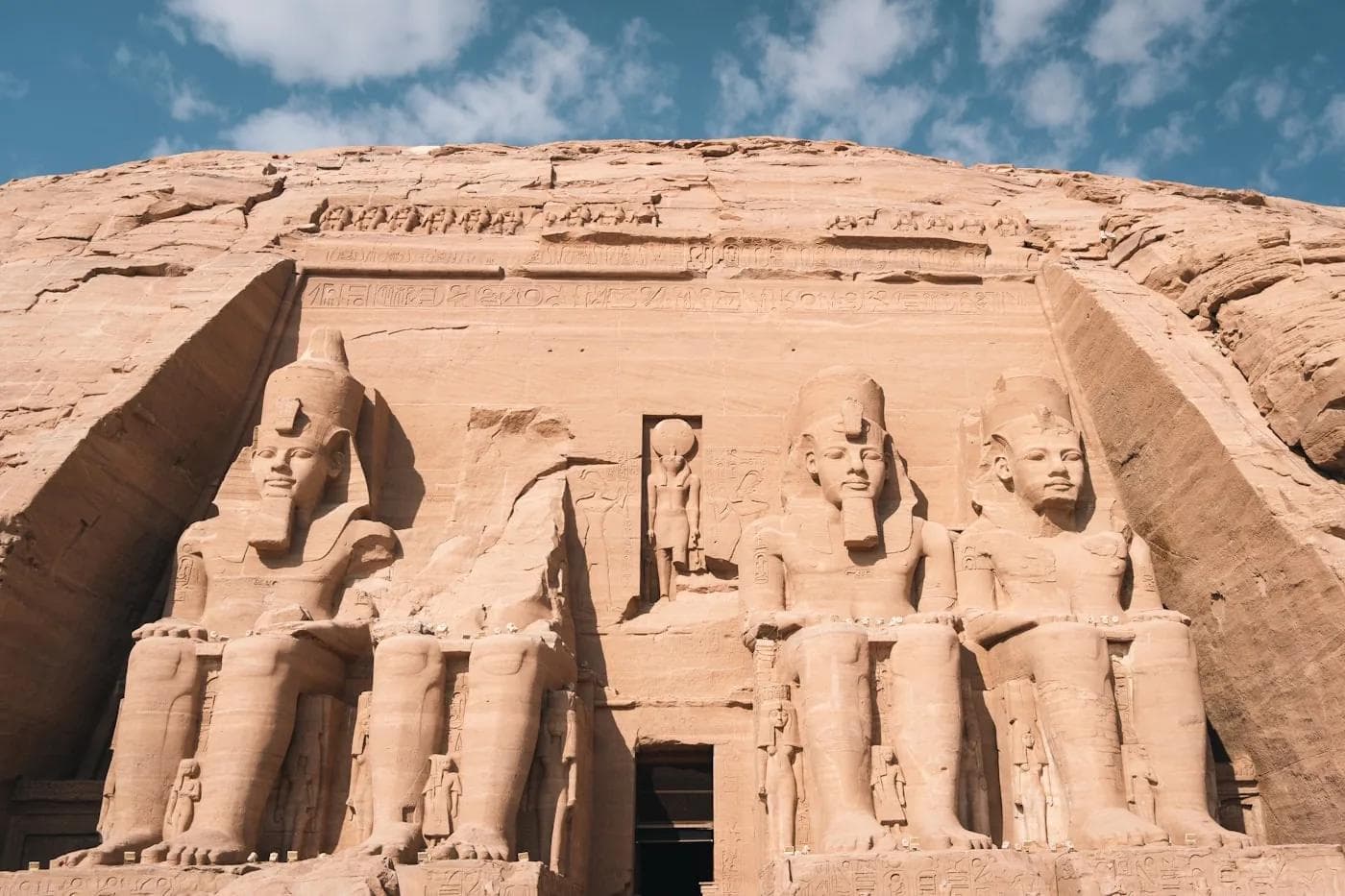
- Four seated colossi close to twenty metres tall on the facade of the great temple
- About 280 kilometres from Aswan: three hours by road or forty five minutes by plane
- Road excursions leave around four in the morning, to be on site at opening time
- Open every day, generally from 6am to 5pm, hours worth checking again before you go
- Two hours on site for a comfortable visit, ninety minutes at the very least
- Sun festival on 22 February and 22 October: the rising sun reaches all the way into the sanctuary
- Temples dismantled and rebuilt sixty five metres higher between 1964 and 1968
- Tickets bought on site or on the official portal egymonuments.gov.eg, prices revised several times a year
Why is Abu Simbel worth the detour?
Because it is the only major site in Egypt where the architecture is not set on the landscape: it is cut into it. Abu Simbel was not built stone by stone like Karnak or Edfu. Around 1264 BC, quarrymen attacked a sandstone cliff and carved two complete sanctuaries out of it, facade included. The four seated colossi that watch you arrive are close to twenty metres tall and are one piece with the mountain: they were never placed there, they were released from it.
Inside, the great temple runs some sixty metres deep. You first cross a hall where eight Osirid pillars bearing the face of Ramesses stand guard, then walls entirely covered with the story of the battle of Kadesh, the longest political communication campaign of antiquity. Right at the back, in the sanctuary, four seated statues wait: Ptah, Amun, Ramesses himself and Ra-Horakhty. The king had himself shown among the gods, at their own scale.
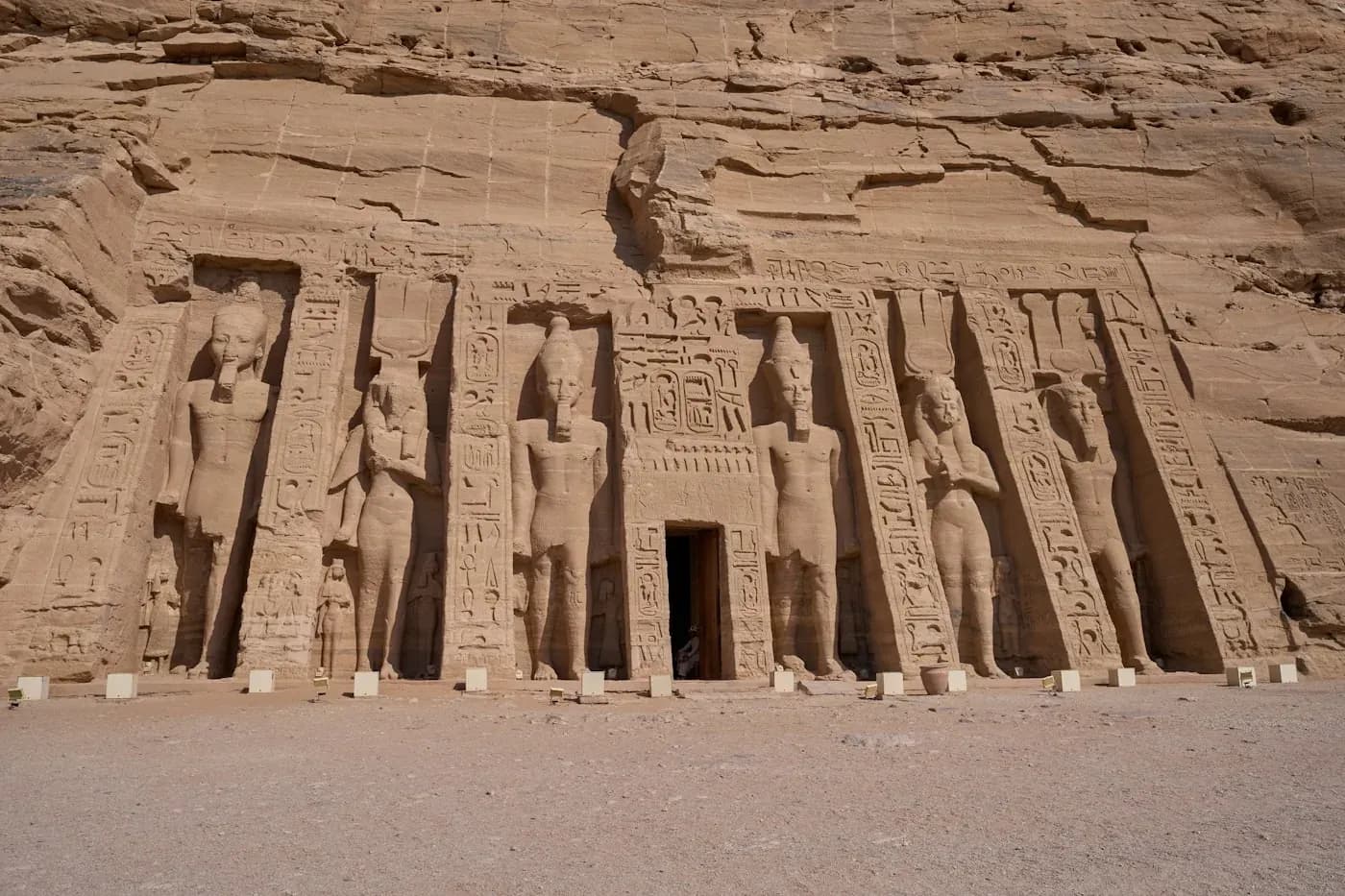
The small temple, a hundred metres further on, is an absolute rarity. Ramesses dedicated it to the goddess Hathor and to his wife Nefertari, and had the queen carved at his own size on the facade. In the whole of Egyptian history there is only a handful of cases where a queen is shown at the king's scale. This is the temple many travellers cross in ten minutes because they used up their time in the great one: it is the most common mistake on the site.
- Great temple: four colossi of Ramesses II on a facade some thirty metres wide
- Hypostyle hall: eight Osirid pillars bearing the face of the king
- Inner walls: the complete story of the battle of Kadesh
- Sanctuary: four seated statues, some sixty metres from the entrance
- Small temple: dedicated to Hathor and Nefertari, six standing colossi ten metres tall
- Rare detail: the queen is shown there at the same size as the king
How do you get to Abu Simbel from Aswan?
By road, by plane or by lake. The road is the most common answer: about 280 kilometres of desert on a straight, decent highway, three hours each way, leaving Aswan around four in the morning. The compulsory police convoy that long governed this journey has not been imposed since the mid 2010s: you travel freely, through regular checkpoints where the driver shows the paperwork. Take water and a packed breakfast, there is nothing between Aswan and Abu Simbel.
The plane costs more but makes the day humane. EgyptAir and Air Cairo link Aswan to Abu Simbel in forty five minutes, with a few rotations a week, usually timed to leave about two hours on the ground before the return flight. It is the right choice for travellers who cope badly with long drives, for a short stay, or in high summer when a night drive followed by the heat makes for a punishing day.
The third option is the finest and the least known: a Lake Nasser cruise. The boat takes three to four nights to reach Abu Simbel by water, calling at Nubian temples that day trippers never see, Kalabsha, Wadi es Sebua, Amada. You moor facing the colossi, and you are still there once the coaches have left. It is a different way to travel, slower, and a different budget.
What we do for our own groups, if it helps as a benchmark: the road from October to April, setting off a little ahead of the big excursions so as to reach the gate first, and the plane from May to September, when the heat makes the afternoon return hard going. In both cases the Egyptologist travels with the group and talks about Nubia along the way, which turns three hours of desert into part of the journey rather than time lost.
- Road: about 280 kilometres, three hours, leaving Aswan around 4am
- No compulsory convoy since the mid 2010s, but regular checkpoints along the way
- Plane: forty five minutes from Aswan, a few rotations a week
- Return flight usually timed to leave about two hours on the ground
- Lake Nasser cruise: three to four nights, with the Nubian temples along the way
- Nothing to buy between Aswan and Abu Simbel: bring water and breakfast with you
What time should you get there?
As early as possible, ideally at opening time, around six. Three reasons pile up and all point the same way. The facade of the great temple faces east: it takes the sun head on at daybreak, and that is the only moment when the faces of the colossi are lit without hard shadow. Then the heat: in Upper Egypt, the difference between seven and eleven in the morning is measured in fifteen degrees. And finally the crowd: the coaches that left Aswan arrive together in mid morning, and the site, which looks vast from a distance, becomes very tight inside the temples.
There is one way to have Abu Simbel almost to yourself, and we recommend it to anyone who can spare a night: sleep there. The village has a few hotels, one of them right on the lakeshore. You arrive the previous afternoon, you are at the gate at opening time, and you visit both temples in silence before the first road excursion parks. It is the only way to see the sanctuary without queuing for your turn. It is an arrangement we set up regularly, and it slots into a classic cruise without difficulty.
- Opening around 6am: the facade faces east and takes the sun head on
- Road excursions all arrive together in mid morning
- An easy fifteen degree swing between 7am and 11am
- Sleeping in Abu Simbel village: the only way to be at the gate at opening time
- Hat, water and closed shoes: there is no shade between the car park and the temples
- Cool but narrow interiors: comfort depends above all on how many visitors are inside
How long should you allow on site?
Two hours is enough, and ninety minutes is a workable minimum. Allow about forty five minutes in the great temple, half an hour in the small one, and the rest for what almost nobody takes the time to do: walk round the back of the hill and follow the lakeshore from the esplanade. Road excursions usually schedule two hours on site, which is just enough if you do not linger at the entrance.
A word on photography, because the rule keeps changing. Taking pictures inside the temples was banned for years, then allowed with a specific ticket. Do not set off certain of anything: the only valid information is the one posted at the ticket office on the day of your visit. Outside, by contrast, there is no restriction, and the best hour is the first one.
- Great temple: about forty five minutes
- Small temple of Nefertari: half an hour, not to be rushed
- Behind the hill and along the lake: twenty minutes almost nobody takes
- Road excursions: two hours on site as a rule
- Photography inside: a shifting rule, to be checked at the ticket office
- Tickets: on site or on the official portal egymonuments.gov.eg
Should you plan your trip around the sun festival?
Twice a year, on 22 February and 22 October, the rising sun pours into the axis of the great temple, travels the sixty metres of the corridor and lights three of the four statues in the sanctuary: Amun, Ra-Horakhty and Ramesses. The fourth, Ptah, a god tied to the underworld, stays in shadow. The phenomenon was calculated by the architects of Ramesses; before the temples were moved it happened on 21 February and 21 October, and that one day shift is the fingerprint of their reassembly.
Should you organise a trip around those two dates? Our answer is frankly no, unless the event matters to you for its own sake. You have to be at the gate well before dawn, with several thousand other people, book accommodation months ahead, and accept seeing the sanctuary over other people's shoulders. On the other 363 days the same temples are visited in peace, with the same morning light on the facade. We would rather choose the season for the climate and leave the sun festival to those who come for it.
- 22 February and 22 October: the rising sun reaches the sanctuary
- Three statues lit, Amun, Ra-Horakhty and Ramesses; Ptah stays in shadow
- Original dates: 21 February and 21 October, before the temples were moved
- Very heavy crowds, accommodation to be booked several months ahead
- The rest of the year: same facade, same morning light, without the crowd
How were the temples saved from the water?
By cutting them up. The Aswan High Dam, built in the 1960s, was going to drown Abu Simbel under Lake Nasser. UNESCO launched an international campaign and, between 1964 and 1968, the two temples were sawn into more than a thousand blocks of twenty to thirty tonnes, numbered, hoisted, then rebuilt sixty five metres higher and two hundred metres back from the shore.
The hill that rises above the temples today is not a cliff: it is a concrete dome clad in stone and sand, built to recreate the mountain that was lost. The blocks were reassembled so precisely that the solar alignment slipped by a single day. Look closely at the faces of the colossi in low sunlight: the cutting lines are still visible. It is the detail we always point out to our travellers, because it tells two stories at once, that of Ramesses and that of the worksite that saved him.
- Rescue operation launched by UNESCO, from 1964 to 1968
- Temples sawn into more than a thousand blocks of twenty to thirty tonnes
- Rebuilt sixty five metres higher and two hundred metres further back
- Artificial hill: a concrete dome clad in stone and sand
- Solar alignment shifted by a single day after the reassembly
- Cutting lines still visible on the colossi in the morning sun
Can Abu Simbel be added to a Nile cruise?
Yes, and it is in fact the simplest way to add it to a first trip. Classic cruises end at Aswan: Abu Simbel is grafted on as an extra day, by road or by plane, usually the day after arriving in Aswan. That is exactly how our seven day cruise is built, keeping a whole day for the deep south where a five or six day format stops at the temple of Philae.
Two operator caveats, because they prevent disappointment. Adding Abu Simbel to a stay of only seven days costs you a tiring day at a point where the programme is already dense; from nine or ten days on, the extension slots in effortlessly. And if you travel in February or March the day is pleasant; in July and August the same day becomes an ordeal, including for travellers used to heat.
- Classic cruise: Abu Simbel is added as one day out of Aswan
- Our seven day cruise keeps a whole day for the deep south
- Five or six day formats: Aswan and Philae, without Abu Simbel
- From nine or ten days of travel, the extension slots in without strain
- Lake Nasser cruise: a different formula, slower, Nubian temples included
- October to April for a comfortable day, to be avoided in July and August
How much does a day at Abu Simbel cost?
The day comes down to two lines: the entrance ticket and the transport. The ticket is among the most expensive in Egypt, alongside the Valley of the Kings and the Grand Egyptian Museum. As for every site in the country, prices are set in Egyptian pounds and revised several times a year: we do not copy them here, the only figure that counts is the one shown on the official portal egymonuments.gov.eg or at the ticket office on the day.
Transport, on the other hand, changes everything. A shared road excursion out of Aswan runs into tens of euros per person; a private car with driver, into hundreds for the group; a return flight, into hundreds per person. In other words, how you travel often weighs more than the entrance fee itself. If money is tight, the shared road trip remains the right answer, provided you accept a three in the morning alarm.
A word on where we stand, so you know who is talking. Osiris runs private days out to Abu Simbel, with a dedicated vehicle, driver and Egyptologist: it is the most expensive of the three formulas, and it is only worth it if you value flexible timings and being accompanied from departure to return. If your budget is tight, the shared excursion sees exactly the same temples, in exactly the same light. We would rather say so here than let you find out afterwards.
- Only two lines: the entrance ticket and the transport
- Among the most expensive tickets in the country, price to be checked on egymonuments.gov.eg
- Shared road excursion: a few tens of euros per person
- Private car with driver: several hundred euros for the group
- Return flight from Aswan: several hundred euros per person
- Reduced rate for students holding an international card
What do our Egyptologists advise for Abu Simbel?
The advice we repeat most is the least spectacular: do not visit the two temples in the order you see them. Most visitors go into the great temple first, spend all their time there, and discover the small temple with one eye on the departure time. Start with Nefertari while the queue builds next door, then take the great temple as the first group comes out. You will see both, and you will see them calmly.
The second piece of advice is about light. Do not put the camera away after the facade: inside, retrace your steps once your eyes have adjusted to the darkness, the Kadesh reliefs read completely differently after five minutes. And keep twenty minutes for the esplanade by the lake: that is where you grasp what the dam would have covered.
- Start with the small temple of Nefertari, finish with the great one
- Let your eyes adjust to the dark before reading the Kadesh reliefs
- Bring a torch, the lighting inside stays dim
- Take water for the road: there is nothing between Aswan and Abu Simbel
- Twenty minutes by the lake, to measure what the dam would have drowned
- In summer, prefer the plane: a night drive then the heat make for too long a day
Related tours
Our trips that match this theme.
Also worth exploring
Égypte
Got a trip in mind?
Tell us what you're after: we'll craft a tailor-made itinerary and reply within 24h, no commitment.
Request a quote